Company
Ongoing Project
Job Type
Research
Scope of Work
Research & Development
Timeline
12 months
Project Start
2026
AI-Powered Global Wildfire Intelligence Platform
NVOKE Labs | Project Report
Project Overview
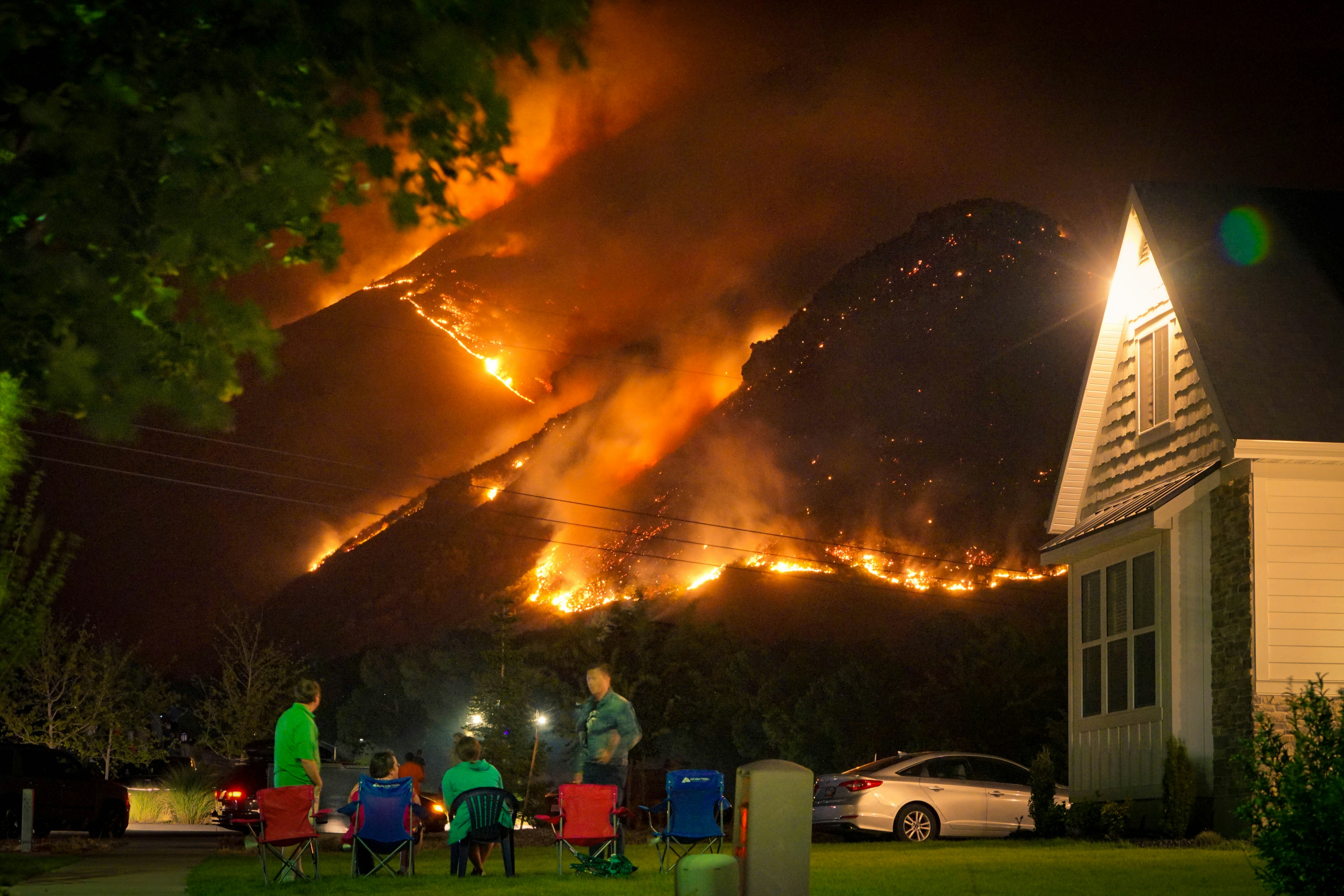
Wildfire is no longer a seasonal regional hazard. It is a year-round global crisis. In 2023 alone, wildfires burned more than 13 million hectares across Canada, emitted record quantities of aerosol pollution across North America, and caused an estimated $3.3 billion in direct economic losses in the United States.
Existing public-facing fire tools, including agency incident maps, basic hotspot viewers, and static weather outlooks, were built for a different era of fire behavior:
They do not forecast
They do not adapt in real time
They do not tell a community how many hours it has before the fire arrives
PYROCAST is NVOKE Labs' answer to that gap.
PYROCAST is a production-grade, open-data-powered global wildfire intelligence platform that renders the entire Earth in real time on an interactive 3D globe and delivers:
AI-driven fire spread forecasts
Emissions predictions
Ignition probability mapping
Community evacuation intelligence with estimated lead times
All running in a standard web browser, at no cost to the end user, using exclusively open government and satellite data sources.
"Where existing research systems forecast fire emissions in isolation as scientific prototypes, PYROCAST integrates forecasting into a complete, user-facing operational platform."
The platform is built to operationally surpass current academic and government forecasting systems, including the 2026 CIRES/NOAA/GMU/UT Arlington sub-seasonal fire emissions system presented at the American Meteorological Society annual meeting.
The platform:
Ingests data from 11 open satellite and atmospheric sources updated on cycles ranging from 30 minutes to weekly
Runs a four-model machine learning ensemble with seven layers of post-processing correction
Pushes live updates to the browser via WebSocket
Is deployable from a desktop folder, version-controlled on GitHub
Requires only a single free NASA Earthdata API token to operate
11 open satellite and atmospheric data sources 4 machine learning models in operational ensemble 7 post-processing correction layers 45 day sub-seasonal emissions forecast horizon
Data Architecture
PYROCAST was designed from the ground up around a philosophy of data density over data simplicity.
Rather than relying on a single fire detection source, the platform ingests and merges three simultaneous satellite streams:
NASA FIRMS MODIS at 1km resolution
VIIRS SNPP at 375m resolution
VIIRS NOAA-20 at 375m resolution
These are deduplication-merged, confidence-filtered, and spatially indexed using Uber's H3 hexagonal grid system, which provides more geometrically consistent cells than square grids and allows fire spread to be modeled directionally across neighboring hexes.
Additional data sources powering the platform:
NOAA Global Forecast System via Open-Meteo API: 16-day hourly forecasts across 30 atmospheric variables including wind speed, gusts, relative humidity, CAPE, and pressure-level temperature readings
NASA SMAP satellite at 9km resolution: soil moisture
NASA MODIS NDVI and EVI: vegetation density and curing state, with a seasonal delta calculation that detects dried grasses
USGS 3DEP Digital Elevation Model at 30m resolution: slope, aspect, terrain ruggedness, topographic position, and wind channeling factors across eight directional axes
NOAA GOES-16 GLM: lightning ignition risk for the Americas, supplemented with WWLLN global data for Africa, Asia, Europe, and Australia
NIFC, EFFIS, AFAC, CWFIS: fire perimeters across the US, Europe, Australia, and Canada
USFS NFDRS: fuel moisture readings from weather station networks
For model training, nine global fire emissions inventories were ingested and harmonized, two more than the seven used in the AMS 2026 research system:
02 - Feature Engineering
Every model input in PYROCAST is a fully engineered composite feature, not a raw observation.
The complete feature vector contains 102 inputs per hex per timestep, organized into eight groups:
Group A: Fire Weather Indices The full Canadian Forest Fire Weather Index system, implemented from first principles:
FFMCFine Fuel Moisture CodeDMCDuff Moisture CodeDCDrought CodeISIInitial Spread IndexBUIBuildup IndexFWIFire Weather IndexDSRDaily Severity RatingKBDIKeetch-Byram Drought Index (0-800 scale)Haines Indexatmospheric instability (2-6 scale)VPDVapor Pressure Deficit with 30-day anomalyERCEnergy Release Component
Group B: Terrain (16 features) Slope, aspect, terrain ruggedness index, topographic position index, wind channeling factors for all 8 compass directions, heat load index, and potential solar radiation.
Group C: Fuel State (12 features) NDVI, EVI, delta NDVI year-over-year, canopy cover, land cover classification, estimated fuel load, curing index for grasslands, and years since last fire.
Group D: Atmospheric State (18 features) Wind speed and direction, gusts, wind shear, mixing height, transport wind speed, CAPE, Lifted Index, solar radiation, inversion flags, and soil moisture anomaly.
Group E: Active Fire State (14 features) Current FRP, FRP density, 30-day FRP anomaly, 7-day FRP trend, fire area, perimeter growth rate, days active, containment percentage, and hotspot counts at 10km, 25km, and 50km radii.
Group F: Historical and Seasonal Context (10 features) Day of year and hour encoded cyclically via sine/cosine transforms, days since last significant rain, 30 and 90-day precipitation anomalies, PDSI, and historical fire frequency per hex.
Group G: Emissions Sequence (10 features) FRP ensemble mean and spread, per-species inventory means, inventory agreement score, AOD at 550nm, and S2S forecast spread as an atmospheric predictability proxy.
Group H: Teleconnection Indices Three climate patterns that influence fire activity at the 35 to 45 day horizon:
MEI v2Multivariate ENSO Index — El Nino/La Nina stateIODIndian Ocean Dipole — drives Australian fire variabilityAMOAtlantic Multidecadal Oscillation — linked to US fire activity
These indices represent the key scientific advance beyond the AMS paper's approach, providing atmospheric memory at timescales short-range weather models cannot access.
03 - Machine Learning Models
PYROCAST runs four distinct models in an operational ensemble, each targeting a different forecasting problem.
Model 1: Ignition Probability An XGBoost and LightGBM ensemble predicting the likelihood of new fire ignition in any non-burning hex within 24 hours. Incorporates a human ignition sub-model estimating risk from road proximity, population density, day-of-week patterns, and historical ignition density from the USFS Fire Program Analysis database. Runs globally every six hours.
Model 2: Fire Spread Predicts the probability that an active fire expands into each of its six neighboring H3 hexes within 6h / 24h / 48h / 72h windows. Uses directional feature engineering to compute wind alignment, slope gradient, and terrain channeling specifically in the direction of each potential spread target. A simplified Rothermel rate-of-spread equation is computed as a physics-based input feature, letting the model learn when and how much to correct the physics estimate.
Model 3: Emissions Regression Six parallel LightGBM models, one per emission species, predicting daily fire emissions from active fire hexes:
Incorporates Modified Combustion Efficiency to distinguish smoldering from flaming combustion and applies land-cover-specific emission factors from Andreae (2019).
Model 4: Sub-Seasonal Forecast (S2S) A two-layer bidirectional LSTM with single-head temporal attention, trained on 90-day rolling windows to predict emissions 1 to 45 days ahead. Architecture:
04 - Post-Processing Correction Pipeline
Model accuracy does not end at training.
PYROCAST applies seven sequential correction methods to every model output before it reaches the API:
Isotonic Regression Calibration — corrects systematic over- and underconfidence in probability outputs, ensuring a stated 70% spread probability reflects an actual observed frequency near 70%
Quantile Mapping Bias Correction — addresses ML regression toward the mean on emissions outputs, preserving extreme event distributions that matter most operationally
Stratified Spread Rate Scaling — applies region-, terrain-, fuel-, and season-specific linear corrections from validation error analysis, eliminating known systematic biases in specific condition combinations
Temporal Smoothing — removes physically implausible jumps between consecutive predictions using exponential weighted averaging and outlier detection
MAPIE Conformal Prediction — wraps all outputs with statistically guaranteed uncertainty intervals, empirically verified to contain the true value at least 87% of the time at the 90% confidence level
Ensemble Kalman Filter Assimilation — runs every hour, using incoming FIRMS satellite observations to correct running predictions in near real time
Spatial Coherence Enforcement — removes implausible artifacts from the hex grid while preserving genuine fire front discontinuities
05 - Globe Interface and Operational Pipeline
The user-facing platform renders on a CesiumJS 3D globe with ten simultaneous data layers:
Animated fire hotspot billboards sized by Fire Radiative Power
H3 hex risk grids colored by spread probability
50,000-particle global wind animation driven by live NOAA data
NASA HMS smoke plume polygons (light, medium, heavy categories)
Predicted fire perimeter polygons at three scenarios and three time horizons
Ember cast probability rings at 5km, 10km, 20km, and 30km radii
Global ignition risk heatmap refreshed every six hours
Post-fire flood and debris flow risk watersheds
Community urgency markers color-coded by evacuation lead time
NASA Black Marble night lights with CesiumJS atmospheric rendering
All heavy computation runs server-side on a scheduled pipeline. The frontend receives pre-computed GeoJSON, rendering at over 30 frames per second on mid-range hardware. A 2D Leaflet fallback activates automatically on low-capability devices.
Project Outcomes
A Platform That Operationally Surpasses Academic Baselines
PYROCAST is held to rigorous quantitative performance thresholds before deployment. These are not aspirational targets. They are hard deployment gates enforced by the test suite.
Model | Metric | Target | Baseline |
|---|---|---|---|
Ignition | AUC-ROC | > 0.85 | ~0.60 climatology |
Spread 24h | AUC-ROC | > 0.80 | ~0.65 persistence |
Spread 24h | IoU vs NIFC | > 0.55 | N/A |
Emissions | RMSE improvement | > 25% vs persistence | — |
S2S Day 35 | RPSS | > 0 vs climatology | 0 |
Calibration | ECE | < 0.03 | — |
Uncertainty | Empirical coverage | > 87% at 90% PI | — |
A New Standard for Fire Intelligence Accessibility
Existing state-of-the-art fire forecasting systems, including FARSITE, FLAMMAP, FSIM, and the NOAA/CIRES research prototype, are scientific tools designed for specialists. PYROCAST is designed to be opened in a browser by anyone:
Emergency managers
City planners and municipal officials
Homeowners in wildland-urban interface communities
Insurance underwriters
Air quality and public health researchers
Journalists and communicators
Every prediction is accompanied by a plain-language SHAP explanation of the factors driving it. Every probability carries an honest confidence interval. Every fire weather index is labeled with human-readable interpretation.
An Open, Extensible Infrastructure
Because PYROCAST is built entirely on free, open government data with no paid API dependencies, it can be deployed by any organization without ongoing licensing costs:
Municipal emergency management agencies
State and national forestry departments
International disaster response organizations
Academic fire research groups
The modular architecture allows individual components to be swapped independently. A new satellite sensor, a higher-resolution fuel map, an improved emissions inventory, or a more accurate spread model can be integrated without rebuilding the system. The platform's GitHub-native deployment model ensures every version is documented, reproducible, and auditable, a meaningful distinction in a domain where forecast credibility is operationally critical.
Real-World Impact Potential
The communities most at risk are increasingly at the wildland-urban interface, where evacuation windows can be measured in hours or less.
"The 2018 Camp Fire in Paradise, California destroyed a town of 27,000 people in under 90 minutes. The 2023 Lahaina fire in Maui killed 102 people, many unable to evacuate in time."
PYROCAST's community evacuation intelligence module directly addresses this. For every community within a predicted fire spread zone, the platform computes:
Lead time to fire arrival based on current spread trajectory
Evacuation clearance time against road capacity and population
Safety margin in hours with color-coded urgency (Green / Amber / Red / Critical)
Vulnerable facility inventory including hospitals, schools, and care homes
Primary and secondary evacuation routes with direct navigation links
A platform that can tell an emergency manager "this community has a 14-hour safety margin on current trajectory, but that drops to 4 hours if winds shift as the 48-hour forecast suggests" is qualitatively different from any tool currently in public operation.
The 35-day sub-seasonal emissions outlook extends this impact to organizations that plan in weeks, not hours: air quality agencies, hospital systems, outdoor labor regulators, and school districts. A forecast that demonstrably beats climatology at that horizon gives those organizations an evidence base for preparedness decisions they currently cannot make with any confidence.
PYROCAST represents NVOKE Labs' commitment to building AI systems where the performance benchmark is not academic publication but operational utility, measured in communities warned, evacuations successfully completed, and decisions made with better information than was available the day before.
NVOKE Labs · PYROCAST · Global Wildfire Intelligence Platform